Politics
G7 leaders meet over diesel reserves as US threatens export ban
G7 leaders joined a video call on 2 October 2026 to weigh releasing diesel reserves after US pressure, with France proposing 100 million barrels and Germany resisting.
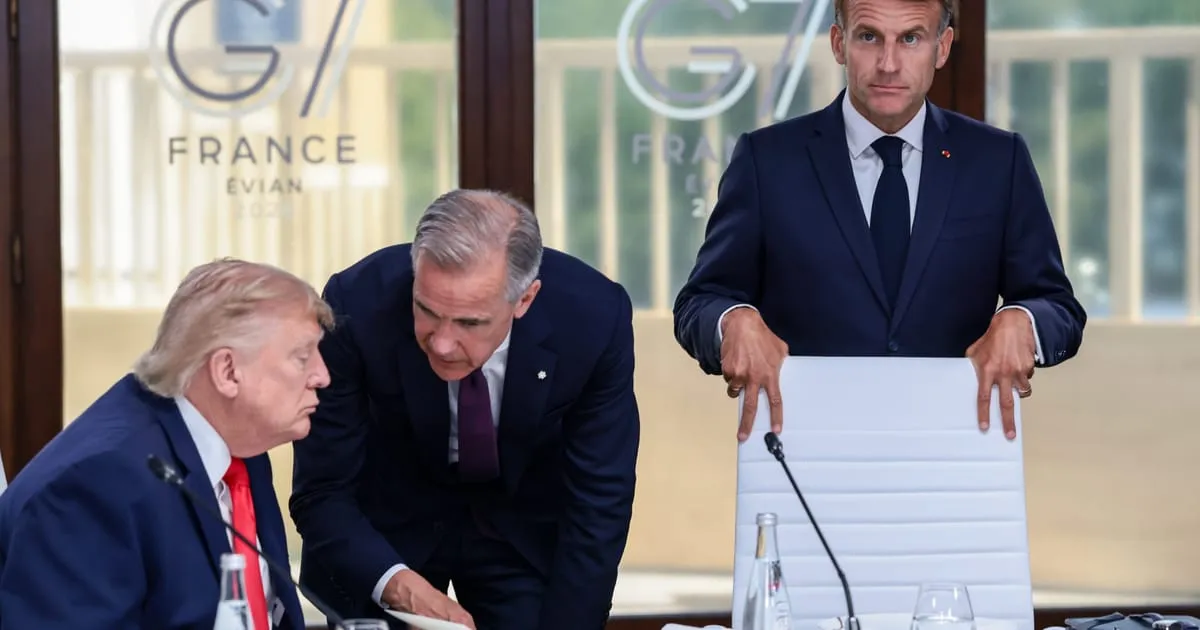 Photo: POLITICO
Key points
G7 leaders held talks on 2 October 2026 on releasing diesel reserves after US pressure and a threatened export ban, with France proposing 100 million barrels.
G7 leaders began a video call at 1230 GMT on 2 October 2026 to coordinate action on fuel prices, after the United States pressured Europe to release strategic diesel reserves and threatened an export ban. French President Emmanuel Macron convened the call after speaking with US President Donald Trump. The Group of Seven comprises Britain, Japan, Canada, Germany, Italy, France and the United States.
The talks matter because a US diesel export ban would cut Europe off from a fuel it relies on heavily, and because record diesel prices are feeding inflation that has reached 3.8 per cent in the eurozone. What is new is the direct US pressure on European capitals to tap stockpiles or face trade restrictions, and the split it has exposed between France, which is willing to contribute barrels, and Germany, which is not.
What the G7 call covers
US Energy Secretary Chris Wright asked European countries to release 120 million barrels from stockpiles over a three-month period to combat rising diesel prices, or else face export restrictions, according to two people briefed on the meeting. US Treasury Secretary Scott Bessent posted that European partners should accelerate delivery on existing commitments and make additional supplies immediately available. President Trump floated a ban on US diesel exports on Wednesday.
At emergency talks on Friday, Paris floated releasing 50 million barrels of diesel and 50 million barrels of crude oil, in response to a US demand to French President Emmanuel Macron on Thursday to release 100 million barrels of diesel over a 180-day period. The idea is still undergoing technical assessment, according to one of the people briefed on the meeting. A spokesperson for French Economy Minister Roland Lescure dismissed the proposal as rumours.
France proposes 100 million barrels
The Elysée palace said Emmanuel Macron will convene a meeting of G7 leaders as soon as possible to coordinate measures to ease pressure on prices and ensure supply of crude oil and refined products among G7 countries and globally. Macron had a phone call with Trump on Thursday night to discuss the global energy situation. British Foreign Secretary Ed Miliband was expected to join the call for the United Kingdom.
Germany resisted. Berlin was reluctant to release any barrels, according to people briefed on the meeting, with one saying Germany and others do not want to be used and wish to release stocks only for real security of supply reasons. Germany and France hold the largest reserves of oil and petroleum products in Europe, according to official European Union statistics. The German government on Friday called for coordinated and reciprocal solutions and warned against unilateral actions.
Germany resists releasing stocks
The European Union pushed back against the threatened ban. European Commission spokeswoman Anna-Kaisa Itkonen said a ban on diesel exports would undermine trust in the United States as a reliable partner, and that the bloc was ready for collective action in the context of the International Energy Agency, which she said has the role of organising possible stock releases. EU trade chief Maros Sefcovic said a ban would have dramatic consequences for economic performance.
The reserves being discussed are already partly committed. The 32 members of the International Energy Agency agreed last March to unlock 400 million barrels of oil from reserves, their largest release ever. Agency head Fatih Birol told reporters on Tuesday after a meeting of EU energy ministers in Dublin that a big chunk had been released but some remained, with about a third yet to come to market and 80 per cent of overall agency stocks still available.
Prices explain the pressure. Diesel prices in the United States and Europe have hit record highs due to the US-Iran war, compounded by a Russian export ban imposed in response to Ukrainian attacks on fuel facilities. Diesel prices in Europe have doubled since February, according to European Commission spokeswoman Paula Pinho. Energy price increases in the eurozone surged to 18.8 per cent in September, pushing inflation to 3.8 per cent, the highest level in three years.
Where the numbers came from
Disagreement runs through the response. Some EU countries criticised France and Germany at a high-level Energy Union Taskforce meeting on Friday for failing to release substantial oil reserves into the market, according to a person briefed on the meeting. A second person said it was unclear whether any release would be coordinated by the EU or done bilaterally, given what they called the messy approach by the United States.
The political stakes are domestic as well as diplomatic. The issue has become a drag on Trump's Republican Party ahead of midterm congressional elections next month, in which it risks losing control of Congress. High fuel costs are a key issue in that run-up. Further EU discussions at ambassador level were scheduled for Friday afternoon, with the Commission denying its stance on the fuel price crisis was being dictated by US pressure.
Frequently asked questions
Why are G7 leaders meeting about diesel reserves?
G7 leaders joined a video call at 1230 GMT on 2 October 2026 to coordinate action on fuel prices after the United States pressured Europe to release strategic diesel reserves and threatened an export ban.
How many barrels has France proposed releasing?
Paris proposed releasing 50 million barrels of crude oil and 50 million barrels of diesel, in response to a US request to French President Emmanuel Macron for 100 million barrels of diesel over a 180-day period.
Why are diesel prices so high?
Diesel prices in the United States and Europe have hit record highs due to the US-Iran war, plus a Russian export ban in response to Ukrainian attacks on fuel facilities. Diesel prices in Europe have doubled since February.
How this story was checked
- Fact-checked against 3 cited pages. 35 figures, dates and quotations in this story were found on the pages it cites.
- Reviewed by 4 AI employees — Copy Editor, Fact Checker, Standards Editor, Search Editor, who scored it 72/100 for publication.
Pages checked (3 of 3)
- politico.euread and checked
- politico.euread and checked
- channelnewsasia.comread and checked
Written by Kaer from public reporting. Checked 2 October 2026.